

Modalità suggerimenti è attiva Disattiva

Prova di 7-giorni Accesso demo

  • Ottieni accesso a tutto il nostro database
  • Fai Screening come un vero professionista
  • Monitora tutti i tuoi titoli quotidianamente
  • Traccia i prezzi dei bond da oltre 400 fonti
  • Prendi decisioni ponderate, basate su dati accurati e completi

Filtra i bond in base a +50 criteri (rating, rendimento, prezzo, ecc.)

Ottieni l'accesso

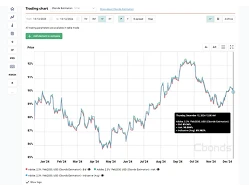
Netherlands Government Bond Yield Curve

Numero massimo di curve da aggiungere al grafico -

Nessun dato per creare una tabella

Netherlands yield curve is a graphical representation of interest rates on Dutch government bonds across different maturities. The term structure of yields represented by this benchmark serves as a reference point for analyzing interest rates and fixed-income market expectations. The curve includes 15 tenors ranging from 1 month to 30 years. Values are published on each business day for the previous trading day.

FAQ

  • What does the shape of the yield curve indicate about market participants’ economic expectations?

    From the perspective of market expectations, each yield curve shape implies a distinct economic scenario:
    • A normal curve points to expectations of sustained economic growth and stable inflation. Investors require a risk premium for holding long-dated government bonds because they remain confident in the sovereign’s ability to service its debt over time. This shape reflects a healthy economic trajectory with no immediate signs of an approaching crisis.
    • An inverted curve signals an elevated risk of recession in the near term. Market participants price in expectations that the central bank will cut its policy rate in response to slowing business activity. Investors’ willingness to lock in lower yields at the long end than prevailing short-term rates reflects pessimism about the near-term outlook and a desire to secure returns before the start of a monetary-easing cycle.
    • A flat curve reflects uncertainty and a transitional phase in the economic cycle: the spread between short- and long-term rates is minimal, indicating that the market lacks a clear directional view. Monetary policy is perceived as restrictive, but its full impact on growth and inflation has yet to materialise. This configuration often precedes a turning point, either towards expansion or contraction.
    • A humped curve points to complex and uneven expectations: the market prices in a temporary rise in rates or their persistence at elevated levels over the medium term, owing to inflation shocks or fiscal risks, while expecting conditions to normalise over the longer horizon. This implies tighter policy in the coming years, followed by a return to lower rates as the economy stabilises.
  • Which maturity combinations on the curve are most useful for assessing the economic outlook for the Netherlands?

    For inflation forecasting, maturities should be aligned with the forecast horizon; for example, the 5Y–1Y spread reflects inflation expectations over the next five years relative to the next year. For forecasting economic activity, the preferred measure is the spread between a long-term rate, typically the 10-year yield, and a short-term rate. Where standard tenors are unavailable, the same principle can be adapted by using the difference between the longest and shortest points available on the curve. Major broad spreads tend to move together, so substituting one for another does not materially change the overall signal.
  • How should the short and long segments of the curve be interpreted given its available tenor structure?

    The curve comprises 15 tenors ranging from 1 month to 30 years.
    - The short-end segment (1–6 months) is influenced by banking-system liquidity and monetary policy. The dense set of intermediate points makes this segment highly responsive to the central bank’s near-term policy decisions.
    - The mid-curve segment (2–7 years) reflects expectations for future GDP growth and inflation and serves as an indicator of the medium-term economic outlook.
    - The long-end segment (7–30 years) is driven primarily by expectations regarding structural stability and sovereign risk. The 30-year horizon serves as a barometer of confidence in the country’s long-term stability.
  • When are the new the Netherlands yield curve values published?

    Curve values are published on each business day for the previous trading day. For example, data for 6 May 2026 are published on 7 May 2026.

I dati sulle curve presenti nella pagina sono disponibili per gli ultimi 3 anni — l'accesso a dati aggiuntivi è disponibile tramite l'API Cbn-data


Contacts

Accesso ai dati
La registrazione è richiesta per ottenere l'accesso.