

Modalità suggerimenti è attiva Disattiva

Prova di 7-giorni Accesso demo

  • Ottieni accesso a tutto il nostro database
  • Fai Screening come un vero professionista
  • Monitora tutti i tuoi titoli quotidianamente
  • Traccia i prezzi dei bond da oltre 400 fonti
  • Prendi decisioni ponderate, basate su dati accurati e completi

Filtra i bond in base a +50 criteri (rating, rendimento, prezzo, ecc.)

Ottieni l'accesso

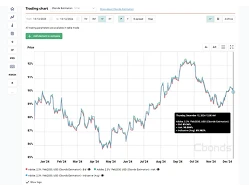
Nigeria Government Bond Yield Curve

Numero massimo di curve da aggiungere al grafico -

Nessun dato per creare una tabella

Nigeria yield curve is a graphical representation of interest rates on Nigerian government bonds across different maturities. This benchmark helps compare sovereign bond yields across different maturities and evaluate changes in interest rate levels. The curve includes 8 tenors ranging from 2 years to 30 years. Yield curve values are published on the second business day following the trading date.

FAQ

  • What conclusions about future interest rates can be drawn from the slope of the yield curve?

    The slope of the yield curve provides information about the likely future path of interest rates and borrowing costs through four main configurations:
    • A normal slope suggests a gradual increase in, or stability of, interest rates. The current monetary-policy stance is viewed as appropriate, while further increases would be expected only if growth accelerated above potential; accordingly, long-term rates are higher than short-term rates.
    • An inversion signals an expected rate-cutting cycle, as market participants assume that currently elevated short-term rates are restrictive, will cool the economy, and will prompt the central bank to reduce rates in the near term.
    • A flat profile reflects expectations that rates will remain high for an extended period or uncertainty about the central bank’s next step. In other words, the market sees no basis for either a sharp rise or a rapid decline in rates, leaving the gap between short- and long-term expectations minimal.
    • A humped curve implies a volatile trajectory: rates first rise or remain near their peak over the medium term, before declining materially at the long end as economic conditions normalise.
  • Which points on the curve are the key indicators of future economic developments?

    Macroeconomic analysis should distinguish between forecasting objectives. For inflation forecasting, maturities should closely match the relevant forecast horizons; for example, the 5Y–1Y spread can be used to assess the difference between inflation expected over the next five years and inflation expected over the next year. For forecasting real economic activity, empirical evidence generally favours the spread between the longest and shortest available tenors on the yield curve; in practice, the difference between 10-year and 2-year yields is often used.
  • How do short- and long-term tenors differ in terms of the information they convey?

    The curve spans a range from 2 years to 30 years and comprises 8 tenor points.
    - In the absence of overnight rates, the short segment does not capture the market’s immediate reaction to central-bank policy; instead, it establishes a baseline for interest-rate and economic-growth expectations over the medium term.
    - The long-end segment (7–30 years) extends far enough to assess ultra-long-term fiscal sustainability and demographic trends.
  • What is the publication lag for Nigeria yield curve data?

    yield curve values are published on the second business day after the trading date. For example, data for trading on 5 May 2026 are published on 7 May 2026.

I dati sulle curve presenti nella pagina sono disponibili per gli ultimi 3 anni — l'accesso a dati aggiuntivi è disponibile tramite l'API Cbn-data


Contacts

Accesso ai dati
La registrazione è richiesta per ottenere l'accesso.